








Related content
Small Interventions, Big Impact: How Nutrition is Transforming Youth Mental Health Care
Small Interventions, Big Impact: H...
At EmberHope Youthville’s psychiatric residential treatment facility, something as simple as a protein snack and water is helping stabilize emotions and improve outcomes for youth.

Therapeutic Day Services Bring Stability, Care for Foster Care Youth
Therapeutic Day Services Bring Sta...
The Therapeutic Day Services Program is the first of its kind in Kansas, and is a partnership between EmberHope Connections and Mental Health America of South Central Kansas.

How Language Access is Expanding Support for Kansas City Single Mothers
How Language Access is Expanding S...
For many single mothers, walking into The Single Mom KC’s Clothed with Dignity Boutique is unlike anything they’ve experienced before.
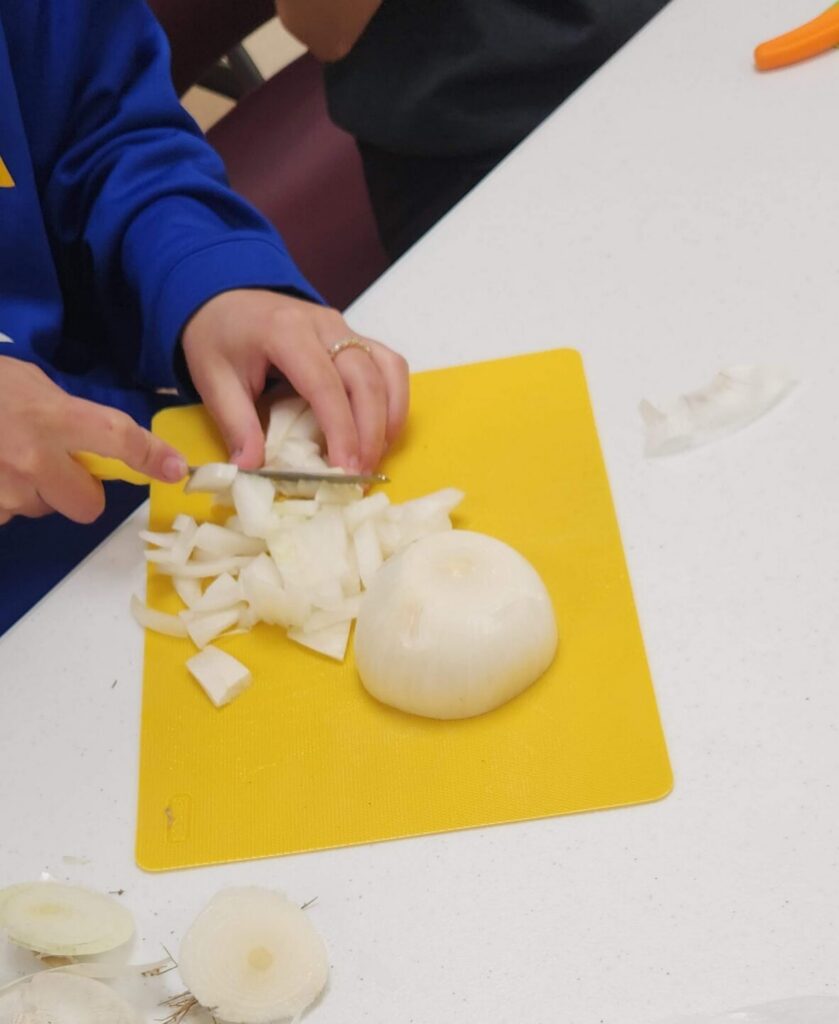
The smell of warm potatoes filled a room at the Parsons Public Library as a group of teen boys clustered around a table, carefully peeling and cutting. It was one of their first times doing it themselves – and a few Band-Aids later, they were proudly stirring a pot of loaded mashed potatoes.
That hands-on moment captures the heart of the library’s growing cooking program, which is redefining what learning looks like inside its walls.
“You don’t think about having a cooking class at a public library. That’s a place for books,” said Samantha Graven, Parsons Public Library director. “But it’s also a place for learning. We take the learning aspect and that discovery and incorporate it into this part of the project. They are learning those skills and building confidence in their cooking.”
From One Burner to a Big Idea
The library launched its with limited tools: a single countertop burner, a pot, a toaster oven, and a griddle set up on tables in its teen room. Early sessions focused on simple meals like upgraded ramen or grilled cheese, chosen specifically to fit the space and available equipment.
Interest quickly grew, revealing both a need and a challenge. The library was running out of room and lacked a permanent kitchen, but building one – like a commercial kitchen – wasn’t an option.
That’s when library staff discovered the Charlie Cart, a fully equipped mobile kitchen that could be rolled almost anywhere in the building.
“The Charlie Cart is a mobile kitchen on wheels that allows us to turn our community room, children’s room, and teen room into a cooking class,” Graven stated in a recent grant application for the cart. “The Charlie Cart comes fully stocked with kitchen equipment, tools, and a K-5 STEM (Science, Technology, Engineering and Mathematics) learning curriculum that participants can learn at the library and take home to cook healthy meals for their families.”
Funded in part by a Kansas Health Foundation grant, the cart includes a convection air fryer oven, hot plates, griddle, sink, cutting boards, utensils, and storage, giving participants the opportunity to cook rather than just watch a demonstration.
Learning by Doing
One of the first times Graven used the Charlie Cart herself, she led a group of teenage boys through making loaded mashed potatoes. As they worked, the students discovered that potato peelers can be tricky. Although a few slips meant lightly scraped fingers, it also taught them to slow down, switch tools, and learn proper knife techniques – all of which the library hopes they can carry into adulthood.
By the end of the class, the students hadn’t just made a meal; they’d gained confidence. Two of them later returned to tell Graven they had made the same recipe again at home with their families.
Led by teen librarian Brandon Tiecke – who brings 20 years of restaurant experience – the program emphasizes hands-on participation, whether students are learning to cut raw chicken, flip omelets, or assemble meals with simple ingredients they already have at home.
Growing Participation and Cooking Confidence
The first Let’s Cook! cooking session drew just nine teens during spring break 2025. Since then, the program has expanded to weekly teen classes and twice-monthly family sessions, serving about 220 participants so far. Classes are held after school and in the early evening to make them accessible to both teens and families.
“We just know that this was a community need and this Charlie Cart is a way to fill that need,” Tiecke said. “We can eat and teach these skills that can help fill their bellies at the same time of them learning something. And kids love to eat. So we’re giving them an excuse.”
Library staff report seeing noticeable changes – from better knife handling and food safety awareness to students trying foods they once insisted they disliked. Recipes often go home with participants, and many attendees come back sharing how they recreated the meals for their families.
Due to its growing success, the library plans to add cooking sessions for younger children, ages 7 to 10.
Graven also hopes to build partnerships with the Parsons Farmers Market, community gardens, or church gardens and to bring fresh, local produce back to the library to demonstrate how to cook with it.
Future classes may include jam and jelly preservation, sourdough bread baking, and garden-to-table demonstrations.
“I’m truly grateful for the funding that we received from the Kansas Health Foundation,” Graven said. “They could visualize the dream with me and had faith in the cooking program. It’s been wonderful for our community.”
###