










Related content
Small Interventions, Big Impact: How Nutrition is Transforming Youth Mental Health Care
Small Interventions, Big Impact: H...
At EmberHope Youthville’s psychiatric residential treatment facility, something as simple as a protein snack and water is helping stabilize emotions and improve outcomes for youth.
Mobile cooking cart sparks community interest, fills need
Mobile cooking cart sparks communi...
Parsons Public Library launched its “Let’s Cook!” program in spring 2025.

Therapeutic Day Services Bring Stability, Care for Foster Care Youth
Therapeutic Day Services Bring Sta...
The Therapeutic Day Services Program is the first of its kind in Kansas, and is a partnership between EmberHope Connections and Mental Health America of South Central Kansas.
Finding affordable, healthy groceries can be tough. Add severe food allergies to staples like milk, eggs, wheat, soy, and peanuts, combined with limited financial resources, and it becomes nearly impossible.
Emily Brown faced this reality in 2014 when one of her two daughters was diagnosed with Eosinophilic Esophagitis, a chronic condition causing esophageal inflammation triggered by food or environmental allergens.
“It was really challenging for us to find and afford the food we needed to keep them healthy,” Brown said of both daughters, who have food allergies. “Prior to the diagnosis, we didn’t really have any financial struggles. That is, until our grocery bill quadrupled overnight.”
Medicaid, the Women, Infants, and Children (WIC) program, and the Supplemental Nutrition Assistance Program (SNAP) provided temporary assistance, and for that Brown was grateful, but she said even food pantries fell short.
“I went to a pantry for the first time here in Kansas City and stood in line for hours, and the only thing available that we could eat were two potatoes and a jar of salsa,” Brown said. One food bank even turned her away because they lacked allergen-contamination protocols at the time.
Meanwhile, allergy-friendly foods carried 30-1000 percent markups, and insurance covered epinephrine only during emergency visits, rather than for preventive care or addressing the underlying diagnosis.
That’s when Brown decided to act for families like hers.
From Struggle to Systems Change
That year, Brown launched a nonprofit to get special dietary foods into food banks and pantries. In partnership with physicians from the University of Kansas Medical Center and Children’s Mercy in Kansas City, the nonprofit created one of Kansas’ first food-prescription programs for food allergy and celiac disease.
Her advocacy expanded into the Food Is Medicine movement, collecting data, publishing food allergy research, and serving as a patient advocate in various state and national advisory roles. In 2021, she founded the for-profit health-tech company, Attane Health.
“All of my work for the last 12 years has been singularly focused on the integration of food and nutrition care into the healthcare delivery system,” Brown said.
Attane Health is a digital health platform focused on improving chronic disease management through personalized nutrition, education, and data insights. It serves Medicaid and employer-plan members with conditions like diabetes, hypertension, maternal health, hyperlipidemia, food allergies, and gastrointestinal issues.
The company partners with healthcare providers and payers to deliver food prescriptions.
Patients receive curated grocery selections – drawn by nutritionists from over 1,500 nutrient-dense, culturally appropriate products – and 1:1 tele-nutrition coaching tailored to their personal health needs and preferences. Groceries are delivered directly to patients’ homes, typically within a day, through Walmart’s fulfillment network or regional food hubs.
Brown said Attane’s services are designed and proven to reduce healthcare costs, drive behavior change, and improve outcomes, supported by data analytics that help providers and payers measure impact.
In 2024, Attane joined the Coding4Food Project to develop standardized Food Is Medicine billing codes. Although the Centers for Medicare and Medicaid Services (CMS) has not approved these codes, Attane continues to work collaboratively with stakeholders and policymakers to enable reimbursement for nutrition prescriptions. In Kansas, Attane partners with UnitedHealthcare to support high-risk Medicaid mothers statewide, including those in food deserts. It is building evidence through this pilot to expand services nationwide.
Attane also compiles proprietary outcomes data for health plans such as UnitedHealthcare to demonstrate the value of integrating food and nutrition care into the healthcare system and to drive systems and policy change.
An Investment in Kansas Innovation
At the Kansas Health Foundation (KHF) HealthRise event in September, KHF President & CEO Ed O’Malley announced a $500,000 equity investment in Attane Health – the foundation’s first in the Food Is Medicine space.
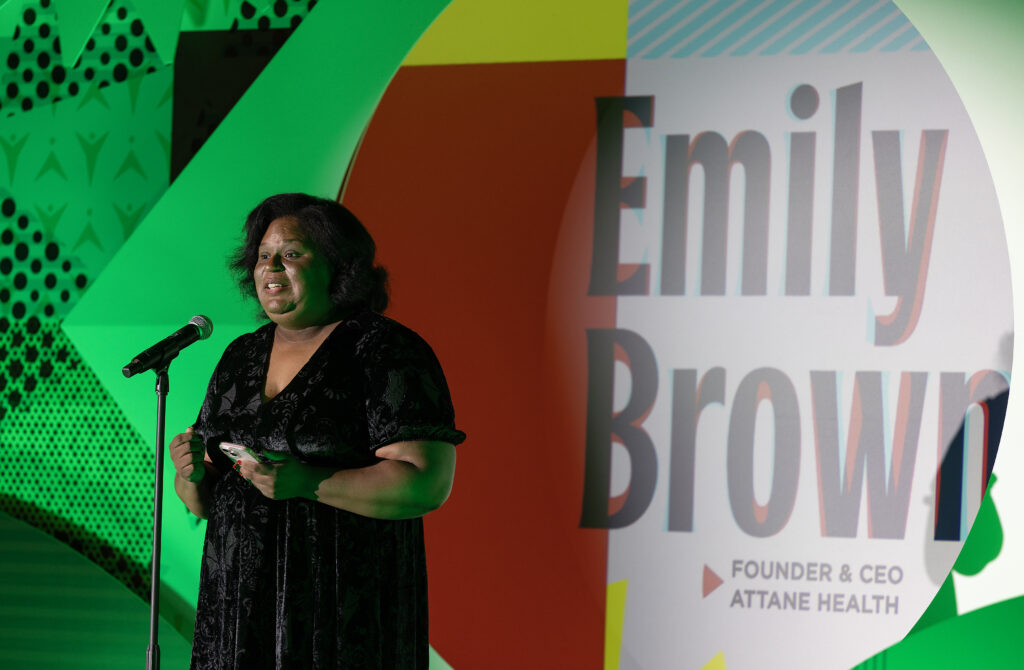
Before she had time to process what was happening, Brown, who was onstage and had finished sharing more about her business, recalls the entire audience standing up and clapping.
“I started crying because it was just at the right time. Those funds have been so critical to Attane,” she said. “I was just so overwhelmed with emotion, but really just gratitude.”
KHF’s equity investment in Attane is one of four 2025 impact investments aimed at improving health across Kansas, said Alejo Cabral, KHF director of philanthropic partnerships.
In 2025, KHF committed to impact investing, using its endowment to invest in mission-aligned for-profit and nonprofit organizations for a financial return. This approach keeps funds working in Kansas communities rather than flowing through conventional markets. Impact investing differs from traditional grantmaking – a strategy the Foundation will continue to utilize – in which funds are provided to nonprofits in exchange for meeting grant requirements.
Founded in 1985 through the sale of Wesley Hospital, a community asset, KHF uses impact investing to reinvest in Kansas-based entities and to support projects that improve health outcomes often overlooked by coastal funders, all while keeping dollars local.
“The Food is Medicine space is a new and interesting way to help our most needy. And with our capital, Attane Health and Emily Brown can continue their work with UnitedHealthcare across Kansas to help these vulnerable families and populations that are facing food security challenges,” Cabral said.
Brown noted that raising capital as a Midwest-based founder is challenging.
“Only 2 percent of venture capital goes to women, and only 0.1 percent goes to Black women,” she said. “I’m on a very short list.”
This investment, Brown said, is among the most exciting of the $5.5 million she has raised so far.
“I also get excited about the transformative power of the Foundation making social impact investing a critical lever in their work,” Brown said. “They are really being the example of how other foundations can leverage impact investing and build these local capital networks that can ensure innovation, and the opportunity for innovation, so it’s available to everyone, regardless of where they live.
I think it’s also really important to build capital networks in your market. So that when Attane is successful, and when we have an exit, our community benefits.”
Travis Green, project director at the Community Investment Project, has been helping KHF explore impact investing since 2017. He said it’s about more than just Attane Health’s success, but also their creativity and ingenuity.
“The foundation is taking a bit more risk in considering opportunities like Attane, with the idea that we need dozens of these types of businesses – entrepreneurs who are thinking in Kansas with Kansas families, with Kansas businesses, about how you change systems meaningfully so that Kansans are healthier.”
A Continued Dedication to Kansas Investments
Over the next decade, KHF aims to bring back tens of millions of dollars for Kansas investments, Green said.
“If every philanthropy in the state says ‘what if we bring back $5 million,’ and collectively thinks about how their resources are invested, and it’s through having dozens of businesses like Attane … then KHF is going to accomplish its mission,” Green said. “I think what’s exciting about impact investing is nobody else has those resources. Those resources that can make a difference already belong to Kansas.”
KHF has long focused on building community assets. In 1999, it launched a 20-year, $60 million Giving Resources to Our World (GROW) initiative.
From 2019 through 2024, KHF used grant dollars to support impact investing across Kansas by encouraging community foundations to view their capital differently; enhancing greater access to healthy food; and improving community health and economic development.
“Before 2023, we were supporting impact investments through grant dollars, and in a certain way, we were impact investors, but we were participating at a different level,” Cabral said. “Now we’re players on the field. We’re not just coaching.”
KHF recently formalized its impact investment policy and due diligence process, involving a diverse internal committee and group of board members. Impact investing strategies include equity ownership, loan programs, direct investments, loan guarantees, credit lines, and securing loans for mission-aligned Kansas projects.
What’s Next for KHF?
Green said there’s one sure way KHF can succeed in reaching its goal of bringing millions back to Kansas within the next decade.
“Kansas already has the resources and tools that it needs to lead the nation in health. It is just a matter of investing them in the right way.
KHF is going to be successful if more investors in Kansas become impact investors; more Kansas investors allocate larger investment portfolios for investment in Kansas and ensure that the investments that are made in Kansas are mission-aligned and mission-fulfilling,” he explained. “KHF is not successful unless it helps other institutional asset holders and investors in Kansas come to the table and start doing this work.”
To make this happen, KHF is actively building an impact investing ecosystem by bringing together and educating foundations, banks, impact investors, and intermediaries across the state quarterly, supported by CoBank’s Rural Prosperity Grant Program.
As it builds the ecosystem, Cabral said KHF encourages these entities to learn, co-invest, and help form a system that makes sense for Kansas.
###
Interested in joining in creating this ecosystem or pitching an impact investment idea? Contact Alejo Cabral, director of philanthropic partnerships, via email at acabral@khf.org to learn more.