









Related content
Small Interventions, Big Impact: How Nutrition is Transforming Youth Mental Health Care
Small Interventions, Big Impact: H...
At EmberHope Youthville’s psychiatric residential treatment facility, something as simple as a protein snack and water is helping stabilize emotions and improve outcomes for youth.
Mobile cooking cart sparks community interest, fills need
Mobile cooking cart sparks communi...
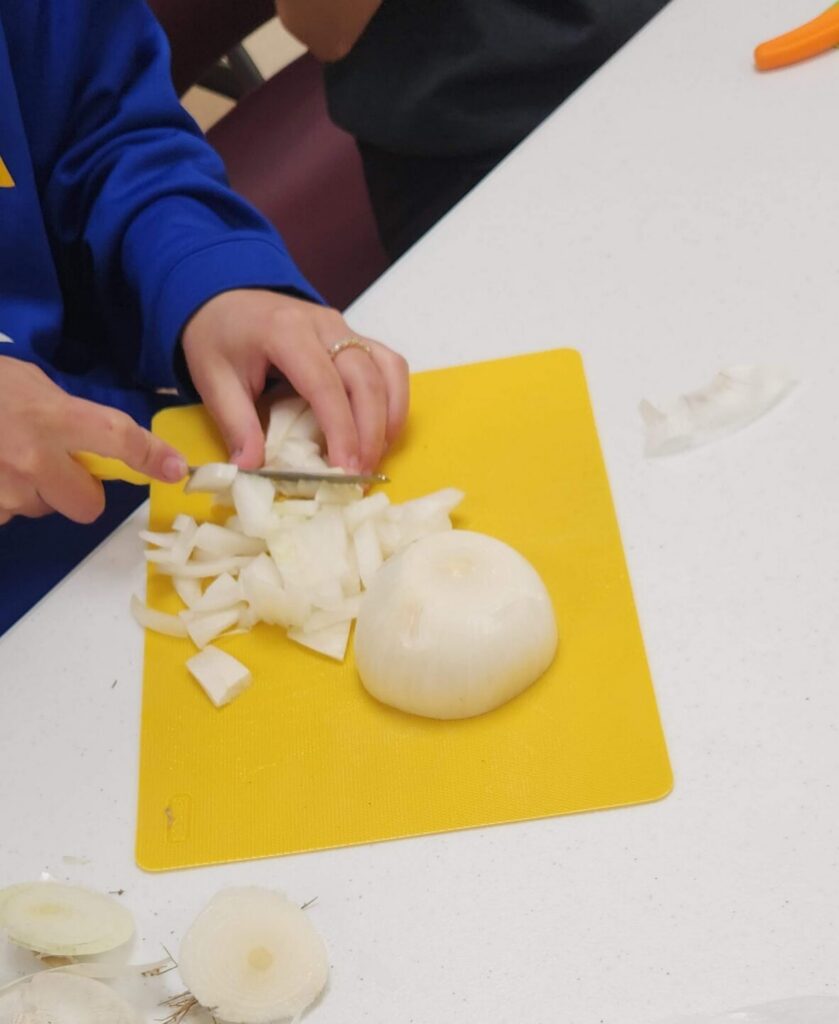
Parsons Public Library launched its “Let’s Cook!” program in spring 2025.

Therapeutic Day Services Bring Stability, Care for Foster Care Youth
Therapeutic Day Services Bring Sta...
The Therapeutic Day Services Program is the first of its kind in Kansas, and is a partnership between EmberHope Connections and Mental Health America of South Central Kansas.
Amar’e Wortman doesn’t have to be at the League 42 indoor baseball facility on an icy cold evening in February. It’s an optional off-season practice.
But as the 7-year-old bats balls off a tee, his parents — bundled up in the chilly facility and watching from nearby bleachers — say he wouldn’t have missed it.
“He’s enjoying the teamwork and being part of it,” his mother, Amanda Wortman, said of the Wichita youth baseball league. “He’s constantly picking up a ball at home and throwing it.”
There’s another reason Amar’e wanted to come: the 7-year-old hitting balls off a tee next to him.
“They met in League 42 and they’re best friends,” Amanda said.
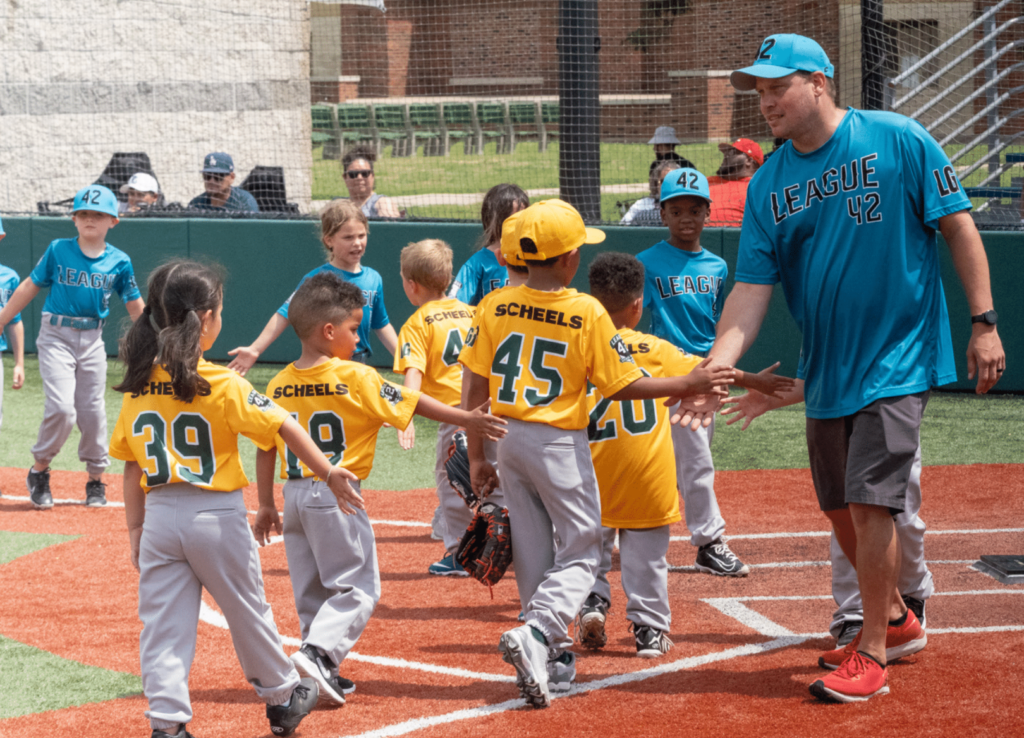
Comments like this run through conversations with the parents and players involved in League 42. The kids love the excitement of hitting and throwing and catching baseballs, but they’re also learning the value of teamwork, practice, friendship and more.
League 42 was started in 2013 by Bob Lutz, a former Wichita Eagle sportswriter and radio personality, to allow boys and girls to play baseball without the high cost associated with many organized sports. The cost is $30 per child or family of siblings, which includes a uniform, a glove (if needed) and any other equipment required. There are five age divisions for the kids, who range from 5 to 14 years old.
Lutz was motivated partly by concern that children of color were turning away from his beloved game. Growing up, his hero was Bob Gibson, the all-time great St. Louis Cardinals pitcher who titled his autobiography “From Ghetto to Glory.” Lutz based the league in McAdams Park, located in a historically black neighborhood of north-central Wichita where athletic legends Barry Sanders and Lynette Woodard grew up and played sports. He named the league for the jersey number worn by Jackie Robinson, the first African American to play in the Major Leagues, and the nonprofit seeks to adhere to nine values attributed to Robinson: courage, determination, commitment, persistence, integrity, justice, teamwork, citizenship and excellence.
League 42 has grown from about 200 players the first year to 620 currently, with a waiting list of 50 more. A majority are kids of color. Most attend Wichita public schools, with a few coming from surrounding towns.
“We have a great mix of all,” Lutz said. “Last year, we had about 225 African Americans and 225 Hispanics and the rest were white or other race.”
The kids practice outside twice a week for five weeks during spring before the season, which runs from mid-April through June. The season is 11 games for the youngest players, 18 for the oldest. With the opening of the indoor facility in 2023, the league has been able to offer some kind of baseball activity year-round.
“We’re basically a full-time baseball operation although we don’t mandate that our kids participate in everything,” Lutz said. “We make it available to them.”
At the optional indoor practice session, it’s clear that the players’ skill levels vary greatly; some throw with an easy, natural movement and a few jump out of the way of any ball that’s tossed their way.
Each of the league’s 46 teams have three or four volunteer coaches; many are parents or grandparents. They bring their own strategies for turning the kids into ballplayers. One throws with an exaggerated overhead motion during warm-ups, trying to show his players how to get the ball where it’s supposed to go. Another has players throw from one knee, so they focus on proper upper body technique. Another, trying to teach a catcher to block a bad pitch with his body, tosses a ball lightly into the boy’s padded chest protector, saying, “That doesn’t hurt, does it?”
Dominic Smith, coach of a group of enthusiastic 11- and 12-year-olds, jokes easily with his players as he runs through drills, occasionally stopping the action to drive home a point. When a player lackadaisically lobs a ball to him, he rolls it back and says, “Try again.”
“Y’all got to run like you mean it!” Smith admonishes after another player jogs through a base-running drill. On his next try, the boy pumps his arms impressively while rounding the bases and scores.
“They’re active,” Lutz said of the program’s physical benefits for kids. “It keeps them from computer games, at least in the time they’re involved with us.”
As much as physical skills and wins and losses, League 42 emphasizes sportsmanship.
“We watch teams very closely to make sure everything that’s going on with a team is healthy,” Lutz said. “We’re very adamant about it. We have field supervisors on the field every night. They keep an eye out for poor sportsmanship, both from players and coaches and also from parents.”
The league hasn’t produced any professional or Division 1 college baseball players yet, but many participants have gone on to play high school baseball and one is slated to play for Tabor College after graduating from North High.
“I’m a competitive person — I want our kids to be good,” Lutz said. “But I also love it when kids go on to be successful in their lives, whatever way that is.”
Parents appreciate the league’s priorities. Jennifer Robinson said she first heard about League 42 from a student she taught in high school. “He’d had a rough upbringing and background, and I think he found his place in League 42. When he talked about baseball, his face lit up.”
She’s enrolled both her sons — Thomas, 10, and Leo, 7. Thomas, it turns out, isn’t crazy about baseball “but he liked making friends and working as a team,” Robinson said. For Leo, who she describes as shy, “It’s helped him build friendships and confidence, and maybe be a little more independent from his parents to some extent.”
Over the years, League 42 has steadily added programs unrelated to baseball but in keeping with Lutz’s desire to serve its players and their families. There’s an annual health fair held in conjunction with Kansas College of Osteopathic Medicine. Twice a year, employees of Mid American Credit Union offer a financial literacy program called Full Count to players and parents. Three or four times a year, players get together with police officers, firefighters and other first responders for an event called Bats and Badges, which might be playing kickball or arcade games or visiting the Sedgwick County Zoo.
Then there’s the Passion Project, which seeks to instill in League 42 participants a sense of what’s possible. Lutz recruits speakers from various fields and professions to talk to the kids about what they do and why. In February, two of Lutz’s former Eagle colleagues, photographers and videographers Jaime Green and Travis Heying, made an appearance to speak about their careers and the documentary they’ve recently made on League 42, called “More Like Jackie.”
Attendance is sparse — “We never know what we’ll get,” Lutz says — but the youngsters who do attend pay attention and ask questions.
When a parent who’s in attendance asks what the pair of journalists learned during the making of “More Like Jackie,” Green responds: “That Bob really loves these kids.”
The biggest change for League 42 came with the 2023 opening of the Leslie Rudd Learning Center, the culmination of a $5 million fundraising campaign (and named for the late businessman whose foundation made a substantial contribution to it) that also generated operating funds. About two-thirds of the center is occupied by the indoor baseball facility, which holds a miniature field and several pitching/batting cages.
The rest contains league offices and a classroom for Bright Lights, an educational enrichment program focusing on reading and math skills. Participating students attend two 75-minute sessions per week.
Meleny Ewers, the league’s education director, said students undergo individual assessments during the first week of each semester. “The assessment allows us to identify how students are preforming in reading or math. Based on the results, we can assign students the skills that allow them to grow academically. It is a great tool to challenge the students who are excelling in their academics, and to assist students who may need more support. Every student is at a different place, IXL gives us the opportunity to meet every student where they are in their academic journey!”
Students use IXL Learning, a computer-based program, during the sessions, but they’re also helped by interns and volunteers, many of whom are Wichita State University students and Rudd Scholars whose tuition is paid for by the Rudd Foundation.
Ewers, a former Rudd scholar herself from Fort Hays State University, said the program has shifted to more one-on-one interaction between the students and instructors over its two-year run.
“I think with technology alone, we wouldn’t see the same progress as when we have the volunteers work with them,” Ewers said. “With the partnership with the Rudd Foundation, we have Rudd Scholars who are very eager to be part of the program.”
The sessions start with a snack and time for the students to visit.
“The first session each week is usually heavy with IXL,” Ewers said. “The second day, we want to make it enjoyable and fun with activities and games.”
For instance, students working on their reading skills are allowed to pick a book to read with a volunteer, who asks questions about what they’re reading.
“It’s really working on comprehension,” Ewers said.
In one of the first sessions this year, the students fidget as interns and volunteers have them list their goals for the year ahead — a task that appears new to most of them.
“You want to try a back flip?” an instructor asks one of the students. “You can put that on there.”
Along with improving in art and reading, “pop a wheelie” and “get my driver’s license” are other goals.
During the same session, the students are brought onto the indoor baseball field for what they’ve been told is a surprise. As they look on, one of their instructors, Lily Delgado, is presented with a poster-sized check for $100,000 — the cost of her tuition and all expenses at Wichita State — by a representative of the Rudd Foundation.
“You know how she got this?” the representative asks the kids. “She worked really hard.”
Delgado cries with excitement.
“Alright, you guys go study hard,” the representative says as the kids file back to the classroom.
So far, Bright Lights has been attracting about 30 students per semester.
“We’re entering our second full year of academics,” Lutz said. “It’s gone well. It’s growing and I believe it will eventually grow to a point where we have to expand the classroom, but we’re not there yet.”
“The kids are really passionate about baseball — that’s the niche,” Ewers said. “They’ve built a wonderful foundation for the league that I think is also going to put our Bright Lights program in good position, too. We’re going to have fun, and we’re also going to learn. It’s a nice balance.”
League 42 became a national news story last year when its bronze statue of Jackie Robinson was stolen by thieves who apparently hoped to sell the metal but ended up destroying it. Donations poured in from around the country and a copy of the statue was created and rededicated last August.
But a bigger story may be the slow but steady growth of League 42 over the years. The league expanded from two to four fields with help from the city and Fidelity Bank, and its list of donors to its fundraising campaign reads like a who’s who of Wichita movers and shakers.
“We just basically open the door now,” Lutz said. “A lot of people know about League 42.”
It’s difficult to fully assess a program with as many moving parts as League 42, but some idea of its impact can be glimpsed by talking to Isai Lopez Cardona, a mature-beyond-his-years seventh grader who’s been in League 42 several years.
Cardona is far from the biggest player on his team, but he’s probably the most focused and has secured the job of catcher, generally considered a team’s coach on the field.
Asked what he likes about League 42, Cardona answers, “I just enjoy the ability to play the game without a cost, just being with a team.”
Cardona says he’s also taken part in the league’s non-baseball programs. “I learned mainly about careers and some about finance.”
Finally, addressing his team’s upcoming season, the 12-year-old sounds like a professional athlete being interviewed on ESPN.
“I feel like we’re going to be pretty decent this year. I like our selection of players.”
Looking on from nearby, assistant coach Stephen Looney can’t suppress a grin.
“We’re teaching our kids how to live through baseball.”
###