





Related content
Small Interventions, Big Impact: How Nutrition is Transforming Youth Mental Health Care
Small Interventions, Big Impact: H...
At EmberHope Youthville’s psychiatric residential treatment facility, something as simple as a protein snack and water is helping stabilize emotions and improve outcomes for youth.
Mobile cooking cart sparks community interest, fills need
Mobile cooking cart sparks communi...
Parsons Public Library launched its “Let’s Cook!” program in spring 2025.

Therapeutic Day Services Bring Stability, Care for Foster Care Youth
Therapeutic Day Services Bring Sta...
The Therapeutic Day Services Program is the first of its kind in Kansas, and is a partnership between EmberHope Connections and Mental Health America of South Central Kansas.
This story is connected to a four-part series highlighting the work of the organizations and communities who received Hunger Free Transformation Grants in 2024.
WICHITA, Kan. – Empty shelves during the COVID-19 pandemic sparked real fear among shoppers trying to find food at local grocery stores, even in Kansas, the breadbasket of the world.
“That was real palpable food insecurity in America that most people in my lifetime had never experienced,” said Rick McNary, international hunger relief expert and owner of Rick McNary Consulting. “People were telling farmers, ‘Thank you, we were scared to death we weren’t going to be able to feed our family, and you came to the rescue.’”
The pandemic revealed the importance of having regional food systems that provide food security both now and during future crises.
That’s where Shop Kansas Farms came in – and later, the Sedgwick County Harvest Hub.
Rick and his wife, Christine, founded the Shop Kansas Farms Facebook group on April 28, 2020, after enjoying beef raised by local friends in Harper County and learning the grocery store meat counter was empty. The effort to connect farmers and ranchers directly with customers grew from 5,000 Facebook members in 24 hours to 50,000 in the first week and more than 130,000 within six weeks.
Today, Shop Kansas Farms has more than 170,000 members and remains a trusted brand where farmers, ranchers and growers post daily about their products, and customers can find and purchase them. In 2022, the McNarys sold Shop Kansas Farms to Kansas Farm Bureau, which had supported the group from its early days.
Meagan Cramer, Kansas Farm Bureau’s director of communications and marketing, said their board recognized Shop Kansas Farms’ potential to connect consumers to farmers and ranchers and, ultimately, help Farm Bureau members thrive.
Some farmers and ranchers relied on selling direct-to-consumer to keep their operations running during the COVID-19 pandemic, she said, while others used it to launch new ventures. Other members were interested in that concept but didn’t have the bandwidth or marketing capacity to get it started.
“[The Board] saw the opportunities and understood the reach of Shop Kansas Farms and the ability it provided to connect consumers to farmers and vice versa,” Cramer said. “When farmers and ranchers are thriving, communities also prosper. It’s a win-win situation, and they knew this was an opportunity to build from.”
Creating the Sedgwick County Harvest Hub
Building on the success of Shop Kansas Farms and the Border Queen Harvest Hub work done for more than a year in Caldwell, the Kansas Health Foundation recently awarded $298,122 to the Kansas Farm Bureau Foundation to create the Sedgwick County Harvest Hub. The Harvest Hub aims to strengthen three key parts of the food system: production, processing and distribution.
This community-based digital platform offers farmers and ranchers tools to showcase their businesses, connect with each other and sell directly to local, regional and national customers. Members also gain access to technical assistance, market development and advertising through Shop Kansas Farms’ 170,000-strong audience.
McNary, who has helped lead the Sedgwick County Harvest Hub, noted that although not all customers can attend weekly farmers markets, many are eager to shop online and connect with local food producers “within two clicks.”
Many people in Sedgwick County have been working hard for years to improve the local food system.
With a background in convening, community engagement, and coaching – and the partnership being led by the state’s largest agriculture organization – McNary believes these individuals and organizations can come together and break down siloed systems, to build a stronger, more impactful and sustainable local food system.
Cramer emphasized the importance of collaboration: “We’re all working toward the same thing of making sure people can access local food that’s healthy.”
“We are different,” McNary said, in sharing the Harvest Hub’s complementary role. “We are really an advertising machine; we’re a marketing machine … People want to know where their food comes from. And people will pay more if there is a story about where it comes from.”
Connecting Farmers and Ranchers with Customers
For Grady Woodard, owner of Woodard Cattle Company in Maize, joining the Sedgwick County Harvest Hub was an easy decision. His 100-head cattle operation sells grass-fed, grain-finished Black Angus beef through whole, half and quarter cuts at Stroot Lockers, and frozen, individual cuts at two of his family’s three Woodard Mercantile Pet, Farm and Ranch Store locations in Maize and Andover.
“It’s crazy to think that some people come in just for ground beef or steaks, but they make that part of their daily routine,” Woodard said.
He credits the Shop Kansas Farms platform with generating 20 percent of Woodard Cattle Company’s total customer base after joining the Facebook group and website in 2020.
“Once we got on the map, it helped us find consumers and draw consumers to us,” he said. “It helped us grow with practically no expense.”
Woodard believes the Sedgwick County Harvest Hub will help other local farmers and ranchers sell perishable items quickly, reducing refrigeration costs and waste, while also making it easier for consumers to find high-quality local products by category and geography.
Addressing Local Processing Gaps
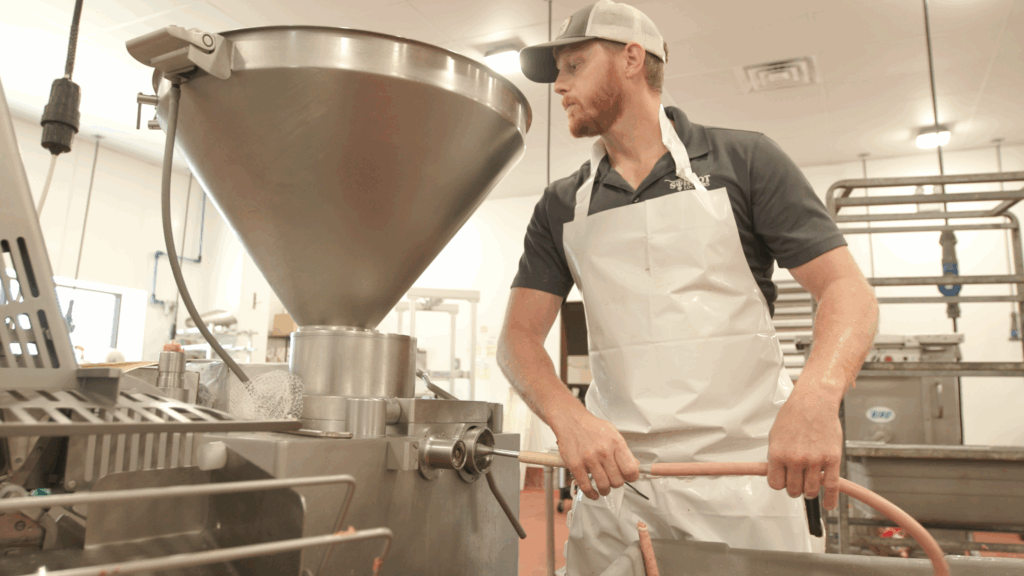
McNary has noticed in recent years that small lockers are closing across Kansas and nationwide, and commercial kitchens with 24/7 access have become scarce.
That’s why, in addition to showcasing local food system businesses and hosting gatherings, the Sedgwick County Harvest Hub aims to address gaps in the local food system, especially those related to processing.
That’s where shared-use commercial kitchens like The Shared Kitchen, owned by Diane Kriwiel, play a vital role.
Kriwiel launched her hourly, membership-based kitchen in June 2024 for small food businesses looking to grow without the cost of a brick-and-mortar location, while ensuring compliance with local, state and U.S. Department of Agriculture (USDA) regulations.
“The kitchen evolved into something bigger than even I expected,” Kriwiel said. “It started out as a catering kitchen for me and has now become a collaborative space where food entrepreneurs can launch, grow and thrive – empowering small businesses and fueling local food innovation.
More doors open for food businesses because there is a commercial kitchen they can access. The Harvest Hub connects producers (growers) with processors (commercial kitchens) to distribution (consumers). And because of Rick and the Sedgwick County Harvest Hub, the word is getting out.”
The Shared Kitchen has space and time for small businesses seeking to process their food and value-added products, and Kriwiel is willing to help connect these local businesses with the appropriate local, state and federal licensing agencies.
For her, joining the local Harvest Hub is about access and opportunity.
“If it creates more avenues and opportunities for other food entrepreneurs, then I’m thrilled,” she said.
Why Sedgwick County?
Cramer noted that Sedgwick County, home to Kansas’ largest city, Wichita, offers a chance to connect urban and rural communities, benefiting the entire county. Smaller towns may not feel connected to Wichita, and the Sedgwick County Harvest Hub provides a bridge for economic and social ties.
She said Kansas Farm Bureau sees the Harvest Hub as a way to strengthen agriculture and Kansans’ lives, aligning directly with its mission. While the membership organization supports both global commodity and direct-to-consumer markets, the Sedgwick County Harvest Hub brings its food system focus down to a micro level, meeting the growing demand for local connections, she said.
Sedgwick County Harvest Hub Priorities and Next Steps
Although work has already begun, the Harvest Hub’s immediate next priorities include:
- Hiring the right local consultant to lead development efforts.
- Producing and launching a video to tell the Harvest Hub story regionally.
- Organizing stakeholder meetings with various groups to encourage collaboration.
- Developing a membership structure for long-term sustainability.
The membership model will help fill gaps left by funding losses, such as those from the USDA to the Heartland Regional Food Business Center, which abruptly ended a $20,000 grant to Shop Kansas Farms for technical assistance.
McNary said the Harvest Hub is exploring creating a certified business trainer program, organized by specialty, to help farmers, ranchers and growers with business principles. A curriculum-based program is also under consideration, so lessons are consistent and scalable.
“When businesses are thriving, rural communities thrive,” Cramer said. “Helping growers and entrepreneurs build direct-to-consumer businesses is an opportunity.”
The Harvest Hub will also host an Andover Market of Farms event on Oct. 4 to highlight Kansas-grown products, share Harvest Hub updates and potentially roll out the curriculum-based program to producers.
By uniting stakeholders, telling producer stories and addressing gaps in the food system, the Sedgwick County Harvest Hub is positioning itself as a catalyst for a stronger, more connected local food economy.
To learn more, visit the Sedgwick County Harvest Hub at sgcoharvesthub.com.
###